Definition of Combat
In C.A.R.P.S., combat is defined as any offensive action taken by a PC or creature
against another PC or creature. This includes melee, ranged attacks, some spells
and some Potions. If you can see or hear combat taking place you are considered
in combat, even if you are not actively participating. This is important to remember
because some spells, Potions and skills may only be used during combat.
Code of Conduct
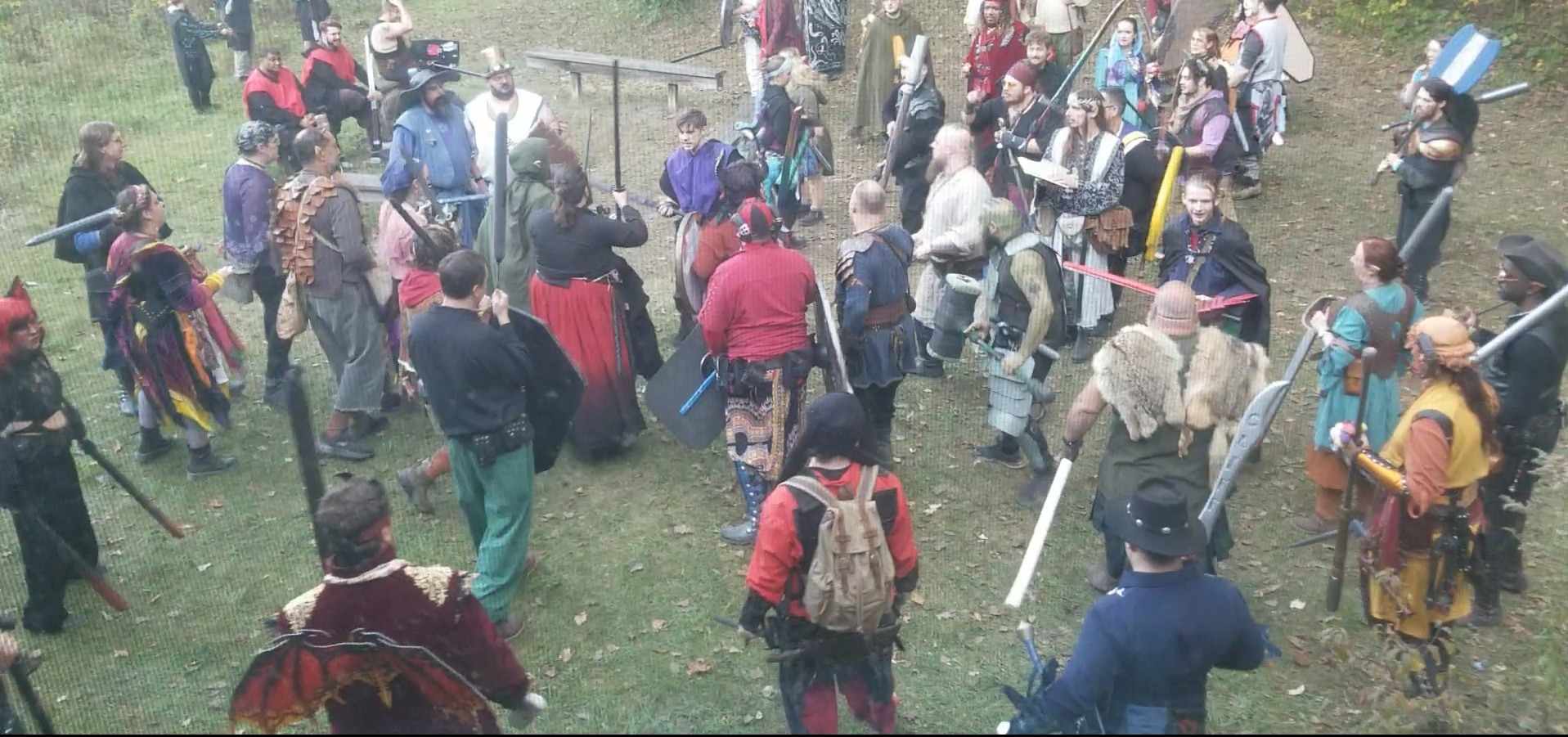
Charging is not allowed! A person is considered to be charging when they are
unable to control themselves safely. If someone is backpedaling away from you
while fighting and you are chasing them, they stop quickly and you run into them …
YOU are charging. The person backpedaling was in control of themselves and able
to stop, you were not. In the event that you are called for charging you
immediately suffer three attacks of whatever damage you deal, or three attacks
from the person you charged, WHICHEVER IS GREATER. Repeated instances of
charging should be reported to a GM so that it can be dealt with as a safety issue.
The C.A.R.P.S. combat system is structured to focus on melee combat; not hand-
to-hand combat, grappling or wrestling. During the course of combat, grappling,
wrestling or hand-to-hand fighting is not allowed. Therefore, there is no reason to
move any closer to your opponent than an arm’s length away. Please be very
aware of this when fighting with a shield. You are not allowed to hit another person
with a shield.
Physically pinning weapons is also not allowed because there is almost no way to
free your weapon without grappling.
Safe Swings
When fighting with a melee weapon, your weapon must be gripped at one end and only the far end may be used for attacking. As much fun as it would be to take a long club and wind it up like a baseball bat; that is simply too much force. All weapon swings must be at least 45 degrees (including your arm, not just the weapon) but not more than 90 degrees and all damage calls must be clearly understandable. This is to reduce the amount of space that you can use to get the weapon moving too fast. Swinging your weapon above your head and straight down inevitably leads to a head hit and should not be done. We also ask that our stronger players please try to control the force of their swing so as not to risk injuring anyone.
During combat, it is perfectly normal to get involved, get the heart rate up and so on. What is not acceptable is to lose control and ‘go to town’ so to speak. This is the fastest way to be removed from combat. If you are involved in combat with another player and that player is going out-of-control, please tell them to calm down. Also, just because you spend Rage to do more damage does NOT mean you should swing twice as hard!
Illegal Hits
You do not have to take damage in combat from swings that hit you in the:
Head
Groin
Wrist
Hand
Head and groin shots do not count for obvious reasons. If you take a hard shot to the groin or head, you are allowed to call a game stop and take a moment to recover. We know this is not enough time to really recover after a groin hit, but you do not have the hour or two that it usually takes. If you are concerned about being hit in these areas, you may bring protection.
Wrist and hand hits are illegal. While that was a common combat tactic during
much of history and in many combat styles, the possibility of a serious injury from a hand or wrist hit is too great.
Purposely blocking with the head, hands, face or groin is not permitted, though we do retain the right to watch and laugh if you try it.
Dealing Damage with a Weapon
To deal damage you must:
Have an appropriate weapon phys rep.
Say the amount of damage your weapon does.
Say what type of damage you are dealing.
There are many different types of damage, but the most common are Edge (from
edged weapons) and Blunt (from blunt weapons). For example, if you were a
beginning PC wielding a sword that can do three points of damage you would say,
“3 Edge” every time you swing it. You do not have to call the full amount of
damage, but you may never call more without using an appropriate spell or skill.
For example, the above PC may call,
“2 Edge” or, “1 Edge.” Sometimes you will come across a special weapon that
deals damage other than Edge or Blunt. In this case read the tag on the item. It
will state exactly what you need to say to hit with the weapon.
Weapons fall into the following damage categories:
Blunt Weapons – Clubs, Hammers, Hand to Hand, Maces, Rocks, Staff
Edged Weapons – Axes, Bows, Crossbows, Dagger, Javelin, Pole arms,
Spears, Swords
Ranged Weapons – Bows, Crossbows, Javelin, Throwing
Determining Weapon Damage
How to determine the “flavor” of your attack:
• Take the base flavor (blunt or edge)
• Apply any skills that constantly change or modify the flavor (Crush or
Vorpal). Your base flavor is now this.
• Add any weapon effects that modify damage flavor (Fire, Magic, Silver, etc.).
IF your base flavor is Crush or Vorpal, you add that modifier (Fire Crush,
Magic Crush, Fire Vorpal, or Magic Vorpal). If your base flavor is Edge or
Blunt, the flavor is replaced by this one (Fire, Magic, Silver), it does not add
to it (would not be Fire Edge, Magic Blunt).
• Expending Skills/Items that change the flavor of your attack for a limited
duration: (Slay for example)
o No matter what your base flavor is, it gets replaced by that Skill/Item
used. Base flavor of Crush or Vorpal would become a base flavor of
Slay when using that Skill (it would not be Vorpal Slay). You can
expend multiple uses of Skills to change the flavor at the same time,
such as Bash or Finesse. Example: If your base damage/flavor is 20
Crush, you can use a Slay and your damage for that attack would be
100 Slay (not 100 Crush). In order to deliver a 100 Crush, you would
need to also expend a use of the Bash skill to convert the damage
back from Slay to Crush.
• When applying multipliers to your damage they are additive not
multiplicative. What this means is that when combining two x2 damage
effects, you get x3 damage not x4. For example, you expend a use of Slay
with your Rage attack and deal 200 Slay. If you also expended a basic use of
Wolverine’s Anger you would do 300 Slay not 400.
• Stacking damage modifiers is only possible if both of them are plus X
damage. The 100 damage from Slay cannot be combined with the +50
damage from Lethal Poison. On the other hand you can combine the +50
damage from Lethal Poison with the +100 damage from Backstab.
Blocking with a Weapon
You can physically block hits with a melee weapon or shield if you do not have the Block skill (wands cannot be used to block). If you block a spell or a crush attack, it will surge and you are still affected. You can choose to block an attack with a crossbow or bow. Each time you use a bow to block it takes a Shatter Effect. A Resist Shatter can be used to counter this. For example, a long bow with five Resist Shatters could be used to physically block five attacks without risk.
Magical Effects
For the purposes of certain defenses magical effects include the following; spells
(designated by the call “Spell”), bard songs (performances), and curses. Other
effects may be considered magical per GM discretion.
Taking Weapon Damage
In C.A.R.P.S. it is inevitable that your PC will be hit for damage in their adventuring career. It is important to know how to count this damage. Every PC has a certain amount of Life Points and Armor Points. These numbers combined determines how many points of normal damage your PC can take before they begin to die. When damage is dealt to your PC, the points are first subtracted from your Armor Points and then Life Points, unless it is Vorpal damage. Vorpal ignores Armor and goes straight to Life.
Armor
There are two basic types of armor in the game physical and mystical. Physical
Armor is most commonly gained through wearing a suit of armor and learning one
of the armor training skills. In this case the armor can be repaired by skills,
abilities, and items that specify they can repair worn armor. Some physical armors
may only be refit by specific skills, abilities, items, or conditions. In these cases it
will be specified within the skill how to repair the armor. Examples of physical
armor include but are not limited to: Worn Armor (chain, plate, or leather),
Dex/Avoidance armor, and Natural Armor. (These armors do not occupy Armor
slots on a person)
Mystical Armor is an intangible protection that comes from alternate sources such
as spells, skills, or items (among other things). Mystical Armor usually occupies an
armor slot, and will specify when it does not. Most mystical armor can be repaired
by skills, abilities, and items that specify they repair Mystic Armor. In a few specific
cases mystical armor may not be repaired, but that will be specified in the ability which grants that armor. Examples of Mystic Armor include but are not limited to:
Ice Armor, Phase Armor, Spirit Armor, and Essence Armor.
When using both Physical and Mystical armor it is the armor wearers choice which
type of armor takes damage first but it is expected that this decision remain
consistent throughout the event.
Damaging Effect vs Non-Damaging Effect
A damaging effect is something that does direct damage to your life or armor
points. Examples include 100 Fire or Eviscerate (bypasses armor and drops life
points to -1). A non-damaging effect is one that doesn’t affect your life or armor
points, but does something to your physiology or psyche. Examples of a non-
damaging effect are “charm enslave” or a “lash destruction” trap going off.
Surging
Surging is a mechanic where if an effect hits you, anything you are wearing or
anything you are carrying it is considered to have affected you. You may use an
appropriate defense in response as normal. The two signifiers of a surging attack
are “Crush” and “Spell”. If you are hit by a weapon or packet attack that involves
one of those two words the effect surges.
Bleeding to Death
When your PC’s Life Points fall below zero, they are unconscious and begin bleeding
to death, which is a 60-count (one minute). You never drop below -1 Life Points.
While bleeding to death, your PC has one minute to be healed to at least zero Life
Points before they are dead. The skill Cling to Life allows you to extend this one-
minute bleeding period.
Life Points at Zero
When your Life Points reach zero, your PC falls unconscious for five minutes. If
your PC is healed to at least one Life Point before five minutes have passed, they
will awaken at their newly-healed Life Point total. If your PC receives no healing
they will awaken naturally with one Life Point at the end of the five-minute period.
Reductions
Some abilities and items grant a 50% reduction to damage. A single Side-step can
be used in addition to this reduction to take damage to zero. In the case where two
different 50% reductions could be applied they DO NOT stack.
Immunities
Sometimes you are hit by something that does not affect you. This could be
damage or a non-damaging effect. If something does not affect you call “No effect.”
If there is a visible reason for this you would also give an indication of why there is
no effect. For example if you are under the effect of an Ice Prison and were hit with
Magic Sleep you would respond with “No Effect, Visible Ice Prison.” It is also
possible that you might not be affected by something because you have an actual
immunity to the effect. In this case you would instead call “Immune” when hit by
that effect.
Definition of
Combat and Scene
Combat: A combat ends when no damage calls occur for one minute of time and there is no immediate threat/danger. For example, after clearing out a level of a dungeon/cave or if monsters stop attacking an area for one minute of time.
Scene: A scene is one of two things; the completion of a conversation, puzzle,
role-play encounter; or the completion of a crafting session. For example, when working on a puzzle, once the puzzle is completed the scene would probably be over and any skills that were enhanced to solve the puzzle would stop being enhanced. If you are crafting and finish a project and decide to take a break and get a drink, stretch your legs, etc. that would end the scene. When you go back and start crafting again you have entered a new crafting scene.
What Happens When Your PC Dies?
At some point in your adventuring career your PC will likely have the misfortune of dying. Once your PC is dead, you can only hope that someone can find your body and afford to have an extremely powerful healer, alchemist, or mage bring your PC back to life. If this does not happen it is time to write up a new PC. Once dead you have 5 minutes past death during which you can be raised from death without a loss of vitality. If you are brought back to life after those 5 minutes, it will cost you one of your 12 Vitality. This occurs each time you are raised. If your starting 12 Vitality are gone, you are dead. All PCs begin with 12 Vitality. Each time you are brought back from the dead you lose one or more points of Vitality. Once your Vitality goes down to 10 or lower it may never be restored back above 10.
Reporting a death or vitality loss
When a PC suffers a vitality loss or is raised
from the dead both that PC and the individual who caused that loss or raised them are responsible for reporting that death and the method of raising to the bar (out of character)! A tracking sheet will be kept at the bar as part of the logistics supplies where either the bartender or a logistics marshal will record the loss or death. This is used to track Vitality loss in the character database.