
A Grand World
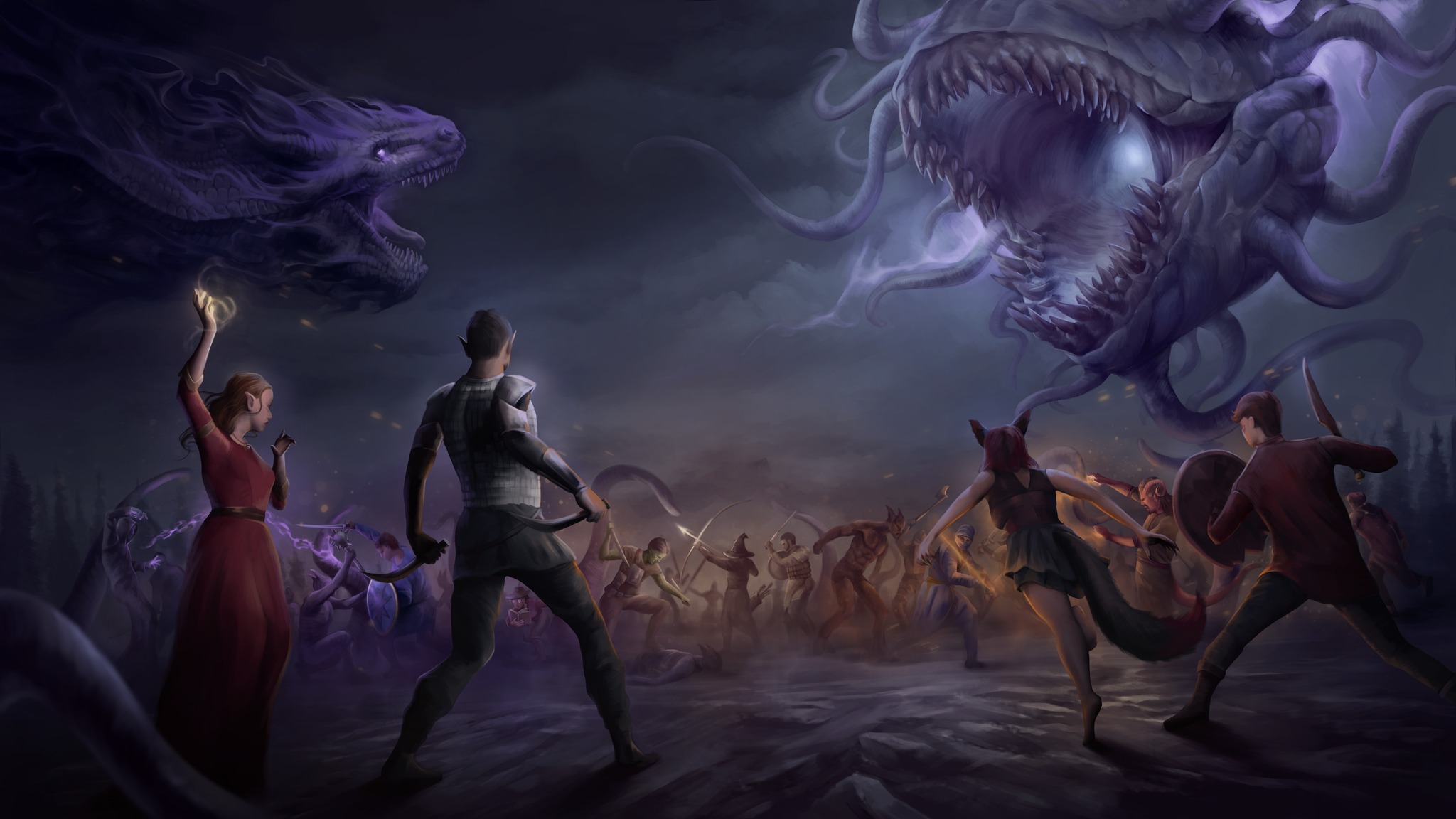
Phantara is a sprawling world of vast oceans, towering mountains, valleys, frozen lands, burning islands, and majestic plains. There is a great amount of places to discover within it and layered between it. The Ancient history of the lands is carved by the people that still carry it, paying head to those that came before them. Kingdoms, Empires, beings of various temperaments have all left their mark across time. Humans, gnomes, elves, orcs, guthrie, efreet, and so many more call Phantara home.
While individuals can come from just about any corner of the world, be it the vast deserts of the west, the frigid sprawl of the north, the secluded kingdom of mages to the east, it is imperative to know where we are directly. The Kingdom of Silverthorne sits squarely in the middle of the continent, connecting to so many different factions. Within it, the duchies, baronies, and thanedoms hold governance.
Within the Duchy of Susspin, the Thanedom of Campbell holds a town of famous (and somewhat infamous) individuals. The Heroes of Midway, strangers from all walks of life in the midst of their journeys gather here. While often forgotten about by the powers of other kingdoms, there are many notable individuals from each that gather here to achieve that which they could not alone.
The Kingdom of Silverthorne
It is a stalwart nation of honor and order. The regional personalities vary wildly thanks to the many challenges each area faces, but one unifying part of Silverthorne’s culture is a deep tradition of Localism, Legalism, and respect for the Rule of Law.
Silverthorne People
The Kingdom of Silverthorne is currently ruled by Queen Johanna Silverthorne. It’s the largest nation in the known world, a stalwart land of honor and order. The regional personalities vary wildly thanks to the many unique challenges each area faces, but some unifying parts of Silverthorne’s culture are deep traditions of Localism, Legalism, and peaceful transfers of power.
Physical Description
Humans are, well, human. The Kingdom of Silverthorne spreads over a huge expanse of the known world, and the humans who dwell within it are varied in every size, color, and shape. There is no biological or magical distinction between humans of Silverthorne and some of its nearby neighbors, like The Great Plateau or Windcrest.
Humans are known for ceaseless ingenuity, fast growth, and medium-length lifespans. This means they’ve been able to thoroughly build up their people and infrastructure in the core regions of the Kingdom, and as such vastly outnumber every other species in the land.
While the capitals and metropolises of the Kingdom are known for comfort and luxury, humans can excel in surviving even the harshest environments, of which there are many even within the nation’s borders. Part of their success can be attributed to their material existence being made of all four elements, their sturdy nature, and nonstop innovation.
Legalism
With the Kingdom’s far-flung people and vast lands, communication and regulation was difficult to say the least. Written communication which might make perfect sense in one region could seem nonsensical to officials reading it in another. What may be a “fair price” in Susspin will be very different to Gilbain. To ease this problem over the years, the people of Silverthorne grew to appreciate and even expect written laws as explicitly as possible.
Local laws could be written to match the local culture without issue, but large-scale sweeping decrees needed to be written in detailed language, which could not possibly be misunderstood, and enforced as literally as possible. This in turn led to a tradition of legal writing and language to avoid loopholes in laws and contracts. And finally, this in turn led to the current traditions of enforcing the “letter” of the law instead of the “intent” of the law.
The people on both sides of long-distance lawmaking and contracts know the writer can’t be expected to know their local customs and opinions, and as such, the words must be taken as written. This of course means the writer has an obligation to be as clear as possible, knowing the people enforcing it will take it literally.
The differences between this law-as-written versus local vernacular is most obvious when comparing a town’s local laws and The King’s Law, but higher-educated officials and those with experience from across the Kingdom will nowadays always find themselves writing and reading things as literally as possible. It has become a large part of Silverthorne culture.
Localism
Dividing the authority of the government into small, compartmentalized institutions is also a key to the stability of the Kingdom. More importantly than that, however, Localization allows locals to have laws and regulations which make sense for their region. The Royals of Silverthorne know the lands are vast and need experts in the field to make policy for their reign.
Thus the Guilds exists, and now rather than relying on a distant and haughty Noble who never saw a live fish in his life to regulate the legal age/weight of fish to keep, it becomes the job of a local Fishing Guild: one which is made of the very fisherman who are incentivized to balance the need to sell fish and also keep their lake from being overfished to death.
In this, the Kingdom and its institutions fostered a culture of solving problems at the lowest-level possible, and it led to much self-sufficiency and independence. Local institutions are masters of their own realms, escalating problems only as needed. As long as they bend the knee to the Kingdom and their Lords (and pay their taxes on time), much variety is found across the legal landscape of Silverthorne at a local level.
Guilds create and enforce the regulations across the land. In the massive Kingdom with very few universal laws, their local regulations keep everything running smoothly and minimize shady business practices.
Peaceful Transfer of Power
Perhaps the biggest success of Silverthorne as a nation is their strict adherence to peaceful transfer of power. In the nation’s entire long history, there have only been two major civil war conflicts. Institutions and Nobles bicker for power and jockey for position, but usually fall far short of large-scale conflict.
Knowing that open hostilities between powers only causes enormous suffering and loss of life, property, and stability, the very culture of Silverthorne itself has shifted to favor more political mind games and clandestine affairs. A common way to “defeat” an irritating rival is to get him a prestigious promotion to a far away post, for example.
Jurisdiction
Two government officials butting heads often leads to major interpersonal stresses in Kingdom rule, especially when no superiors get involved to settle the matter as to avoid favoring either faction. This has led to The Right to Jurisdiction in some Duchies, where a Noble’s laws take precedence over any traveling Noble’s conflicting orders on their land.
The concept of The Right to Jurisdiction grew popular and quickly spread among other organizations as well, including the Houses and Guilds. Even though it has not been codified into law in many places, it is traditionally respected as a powerful means to resolve conflicting laws across borders within the Kingdom.
A Noble is never considered to be officially reduced in authority or power while away from their lands, although this may certainly be the case practically. A Noble of Silverthorne is always a Noble of Silverthorne, and a local Head of a Guild is always that, no matter where they go. The Right of Jurisdiction specifically and only means a traveling Noble’s judgements are not valid if they conflict with a local peer’s judgements. New judgements which do not conflict are still valid.
Society
Most of Silverthorne society, not just humans, are at least aware of the potential dangers of mages in political positions. This is a cultural remnant of the previous geopolitical power in this land, The Mageocracy. A lack of understanding leads to a lack of trust, and it’s very rare to find a high-ranking government official be a mage themself, although many will have court mages in their retinues to give guidance and advice.
Daily life in Silverthorne cannot be described in broad terms, as it varies too much from place to place. Most citizens of Silverthorne are farmers, peasants sworn to care for their land in return for protection and government services from their Lord. A small but growing “Middle Class” of merchants and tradespeople is starting to build a real economy.
The land is criss-crossed by a network of roads, the lifeblood of the Kingdom, each one regularly dotted with villages and hamlets like beads on a necklace. Village life is small and quaint, often relying on farming, mining, lumber, or fishing. Some regions of the Kingdom are plagued with supernatural dangers while others are considered very safe. Either way, villagers are fearful of traveling too far from their familiar countryside. Everyone knows everyone else in village life, and gathering information as an outsider is difficult if one is not trusted. The roads all lead to and interconnect with the major cities, which the villages all orbit.
Here is where one will find the most skilled tradespeople and brightest scholars. The pinnacle examples of what stability and trade can bring a civilization, some of Silverthorne’s cities are world-renowned for their luxury and comfort, even among the peasants who live and work there. A respected Peasant handmaid in the Kingdom capital of Silverthorne City may very well have a more comfortable life than many “country” Freemen.
The cities are also where people must flee to when they can’t farm, to look for a new way to live. They are the seat of power in a region, often housing all the government institutions and Nobility which rule it, so there are many jobs for chambermen and assistants. Cities are also the economic powerhouses, tradespeople importing the vast majority of the raw resources the surrounding villages harvest, making yet more jobs for skilled and unskilled laborers as well. Beware, however, along very narrow and twisted streets of stone or wood, desperate criminals, snooping spies, and the grim dregs of society dwell. Each city has a different personality, sometimes varying by time of day, and they can be dangerous to travelers who aren’t familiar.
It is an unfortunate truth that Silverthorne has a long history of being highly guarded and fearful of outsiders. The Kingdom is surrounded, within and without, by dangerous or hostile powers both geopolitical and supernatural. Its people learned long ago to only trust each other, since no one else has their best interests at heart. It has become human nature to fear The Other, and especially those with less travel or worldly experience can be quick to judge what they don’t understand.
Even the most broad-horizoned and understanding humans in Silverthorne may often downplay criticisms of the government, arguing that while certainly flawed, these systems were put in place for good reason at some point in the nation’s difficult history with the other powers around Phantara.
It sounds contradicting at first, but the most well-learned legal practitioners in Silverthorne believe nobody but the King is “above the law”. They simply mean there are different laws to govern different aspects of society, and just like a Peasant has laws they must follow, so too must Nobles follow theirs.
Peasantry
The largest demographic in the Kingdom is the peasantry, typically the poorest folks who rarely travel beyond their village and have only the vaguest sense of the larger world. They tend to hold very little patriotic loyalty to the Kingdom itself, but rather to their local Lords. Having very little money in coins, peasants agreed to swear an oath of allegiance to a landowner in exchange for a parcel of that land to call home for themselves.
The exact details of a peasant’s oath, called an Indenture, depends entirely on the Lord in question and vary wildly from place to place, with each region of Silverthorne having different traditions for what the oath contains. Sometimes it is even a negotiation between the would-be Peasant and the Lord. To generalize, the Peasant swears to take care of the land, maintain it, and call it home, a full-time job. In return, the Lord swears an oath back to the Peasant, to defend the Peasant and make sure their needs are met, connecting them with the rest of the government, and representing their best interests in lawmaking matters.
There is great cultural significance in this oath, both Lords and Peasants alike insist they are doing so willingly and with great dignity, despite the imbalance of power in the agreement. Most peasants take pride in their land and homes, working diligently to improve their lot in life, and genuinely hate being compared to slaves. Most peasants sincerely consider the farms they maintain to be their own, and wise Nobles don’t disagree.
Freemen
Freemen are people who do not owe allegiance to any one specific Lord. They are not sworn to maintain a specific plot of land, but as such do not get the privilege of living on one. Freemen are tradespeople, crafters, mercenaries, and merchants who make a living with coin instead.
They often live on the road, traveling to ply their trades, or rent space for workshops to produce goods and services. The wealthiest Freemen can eventually save up enough gold to buy a piece of land for themselves from a Noble, and Silverthorne has developed a small but growing middle class of such Freemen merchants.
Nobility
Nobles are the landowners and, more importantly, the absolute rulers of the Kingdom. Most are direct descendants of the revolutionaries who defeated The Mageocracy and created Silverthorne, each taking chunks of land as a reward for their bravery and loyalty to the new King many generations ago. The land belongs to them, and when Freemen visit their realms, they expect their rules to be followed as if the Freeman was a guest in their home.
Sometimes there can be “Un-Landed Nobles” who don’t rule any specific land of their own, but their hereditary title and social connections to the rest of the Nobility still gives them enormous power in lawmaking and business.
The more distant a Noble’s relation grows with the Kingdom’s royal family, they eventually become known as “Gentlefolk,” though the distinction is sometimes arguable and usually relies on how powerful they are in practice. With some exceptions, this is typically a title for the third and fourth children of Nobles and beyond, as well as Freemen who are married into a Noble family.
The relationships among the Nobility are multifaceted, complicated, and sometimes adversarial. The Royal Family rules as absolute monarchs, but traditionally, take great care to rule with the consent of their highest-ranking Nobles. As such, the Nobles often must gather in councils to solve big problems as a group, relying on ad hoc methods of simple democracy agreed upon before each council. There is no official process for a Noble council, so each one is run differently, and they usually have unique names and histories. One example: The 1019 Council of Dorchek which met to discuss quelling the rebel Duchy.